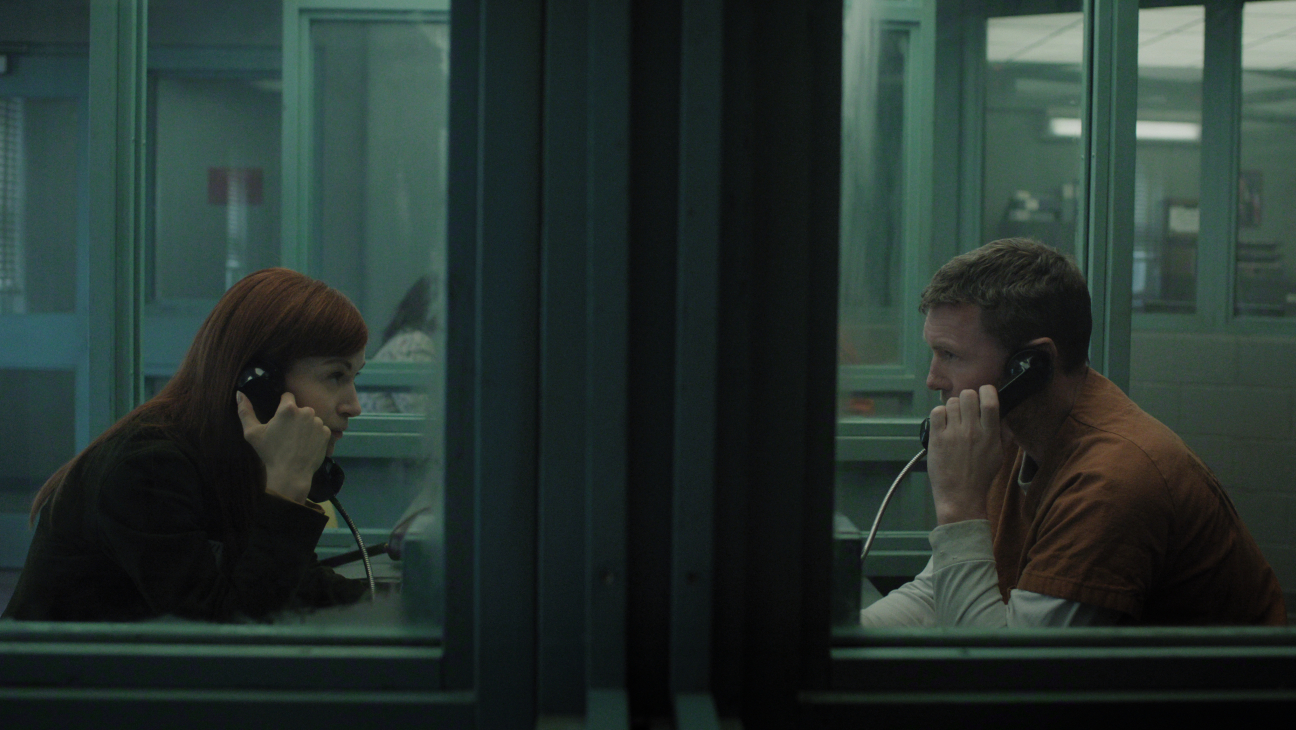
An aspiring actress in an army role-playing facility
falls in love with a soldier
in Hailey Gates’ feature debut, staring Callum Turner and Chloë Sevigny
The American militaryâs long history of constructing fictionalized environments for training purposes has provided filmmakers with fertile ground for thematic exploration. From Sierra Pettengillâs Riotsville, USA to various critiques of the military-entertainment complex, the subject remains a compelling one. Hailey Gatesâ feature debut, Atropia, sets out to satirize these artificial war zones by following an aspiring actress caught within the machinery of U.S. military training. With an engaging premise, an impressive ensemble led by Alia Shawkat, and Luca Guadagnino backing the project as a producer, Atropia carries the weight of high expectations. However, despite moments of biting critique and visual ingenuity, the film struggles to maintain a coherent focus, ultimately diffusing its satirical edge and diminishing its narrative effectiveness.
Set in a meticulously constructed role-playing facility designed to prepare American soldiers for combat scenarios, Atropia follows Fayruz (Shawkat), a committed actress whose job involves portraying a range of characters, from Iraqi civilians to chemical weapons experts. Expanding on the premise of Gatesâ short film Shako Mako, which introduced a similar protagonist navigating an artificial war zone, Atropia introduces an additional romantic subplot that ultimately detracts from the filmâs more potent critiques of militarized propaganda.
Fayruz’s aspirations are clearâshe hopes to leverage her experience in Atropia to transition into real acting work. However, Gates’ most incisive commentary lies in her depiction of the larger system that enables such environments to exist. The film subtly interrogates the mutually beneficial relationship between the military and Hollywood, highlighting how film industry professionalsâset designers, costumers, and even actorsâparticipate in crafting immersive training scenarios that blur the line between performance and real-world conflict. These insights, however, are often undercut by a fragmented narrative that shifts attention away from systemic critique in favor of an underdeveloped romantic arc.
One of Atropiaâs more intriguing dimensions is its depiction of the actors conscripted into these artificial scenarios. Fayruz takes her assignments seriously, approaching them with the intensity of a method actor, while her colleaguesâparticularly Noor (Zahra Alzubaidi)âview their roles with cynicism. This contrast provides some of the filmâs sharpest observations, particularly in how the performers rationalize their participation in the military machine. Yet, rather than delving deeper into these contradictions, Atropia veers toward an unevenly executed romance between Fayruz and Abu Dice (Callum Turner), a soldier undergoing training. While Shawkat and Turner share a natural chemistry, their relationship feels like an extraneous narrative detour rather than an organic development.
Gatesâ decision to intercut real-life wartime footage into moments of intimacy between Fayruz and Dice is particularly jarring. This stylistic choice, rather than reinforcing the absurdity of the constructed environment, disrupts the filmâs tonal balance, making it difficult to engage fully with either the love story or the broader critique of militarized storytelling. Additionally, the filmâs more comedic elementsâanchored by strong but underutilized performances from Tim Heidecker and Chloë Sevigny as Atropiaâs overseersânever fully coalesce into a cohesive satirical framework.
POPULAR ON THE CINEMA GROUP
Despite its structural shortcomings, Atropia benefits from strong performances, particularly from Shawkat, whose comedic instincts and emotional depth elevate Fayruz into a compelling, if underwritten, protagonist. Turner also delivers a nuanced performance, though his characterâs motivations remain frustratingly opaque, limiting the audienceâs emotional investment.
Cinematographer Eric K. Yue effectively captures the surrealism of Atropia, alternating between stark, documentary-like precision and the theatricality of a fabricated world. Production designers Ashley and Megan Fenton construct a convincingly immersive environment, complete with its own currency, propaganda networks, and simulated economies. These details lend the film an impressive aesthetic authenticity that underscores its thematic concerns, even when the script struggles to articulate them fully.
Atropia is a film brimming with ideas but lacking the narrative discipline to explore them fully. Gates presents a fascinating premise that interrogates the intersections of Hollywood and the military-industrial complex, yet the filmâs competing prioritiesâromantic drama, satirical critique, and political commentaryâoften work at cross-purposes. Had the film doubled down on its incisive observations about military propaganda and the commodification of war, it might have landed with greater impact. Instead, it remains an intriguing but ultimately uneven cinematic experience.
Despite its tonal inconsistencies, Atropia offers enough compelling momentsâbuoyed by Shawkatâs standout performance and its richly detailed world-buildingâto make it worth a watch. However, as a satire, it stops short of delivering the razor-sharp critique it seems poised to offer.
Rating: â â â ââ
Title: Atropia
Festival: Sundance (U.S. Dramatic Competition)
Director-screenwriter: Hailey Gates
Cast: Alia Shawkat, Callum Turner, Chloë Sevigny, Tim Heidecker, Jane Levy
Sales agent: UTA Independent Film Group, WME
Running time: 1 hr 26 mins
THE CINEMA GROUP – YOUR PREMIER SOURCE FOR THE LATEST IN FILM AND ENTERTAINMENT NEWS. FOLLOW US ON SOCIAL MEDIA @THECINEMAGROUP